


Understanding apostilles is essential for international document acceptance. This process guarantees legal validity and recognition for important paperwork such as visas, marriages, and adoptions. An apostille verifies authenticity under the Hague Convention, ensuring legal recognition in the destination country. It simplifies the authentication of public documents for cross-border use, streamlining international recognition. Notarization and thorough verification are vital for proper authentication. Consider proper notarization and submission processes. If you seek further insights into the apostille process and document authentication, more details are available in the detailed research.
What Is an Apostille?
An apostille is an essential form of authentication required for documents used in foreign countries under the Hague Convention. It serves to verify the authenticity of the document and guarantee its legal recognition in the destination country. This process of document authentication is vital for various legal purposes such as visas, marriages, and adoptions. Without an apostille, documents may face rejection by foreign authorities, leading to potential legal complications or delays in proceedings.
Established through the Hague Convention of 1961, the apostille streamlines the process of document authentication for international use. This international treaty simplifies the validation of public documents to be recognized across participating countries, promoting efficiency and trust in the legal systems of member nations. By adhering to the standards set by the Hague Convention, countries can facilitate smoother cross-border transactions and legal proceedings, offering individuals and organizations the necessary assurance of document authenticity.
Hague Convention Overview
The Hague Convention on Apostille is an international treaty that simplifies the authentication process of public documents for cross-border use. Established in 1961, the Hague Convention Abolishing the Requirement of Legalization for Foreign Public Documents aimed to facilitate the international recognition of documents by introducing the apostille. This agreement eliminates the need for further legalization of documents by foreign authorities, making it easier for documents to be accepted and utilized across member countries. When a document is apostilled in accordance with the Hague Convention, it signifies that the document is valid and authentic for use in any signatory country. This streamlined process has greatly benefited individuals, businesses, and governments by reducing bureaucracy and ensuring the efficient validation of public documents for international transactions. Embracing the apostille system under the Hague Convention has enhanced the global acceptance and accessibility of public documents, fostering smoother cross-border interactions.
Document Authentication Process
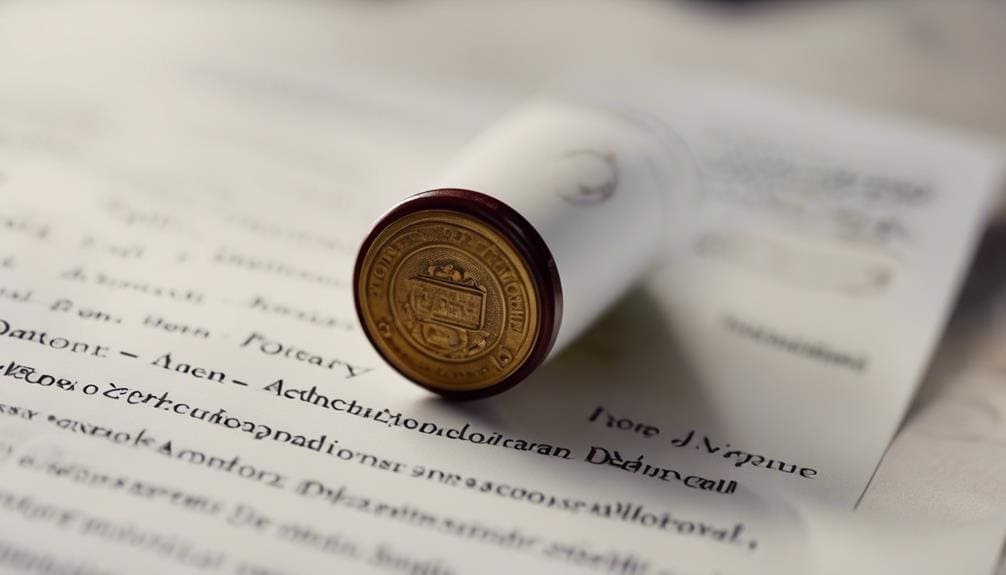
Efficiently authenticating documents for international use necessitates thorough verification and certification of official signatures. When preparing documents such as diplomas, powers of attorney, or adoption dossiers for overseas purposes, it is important to make sure that they are properly authenticated. This process involves submitting the original documents along with specific details about the destination where the documents will be used and the reasons for authentication. The state's Notary commissioning authority plays a significant role in determining whether an apostille certification or authentication certificate is required based on the laws of the destination country. Proper notarization is essential to guarantee that the documents are accepted and acknowledged in foreign jurisdictions. By following these authentication procedures diligently and accurately, you can ensure that your notarized documents receive the necessary authentication for international recognition and validity.
Notarization Requirements
You must guarantee that the notary seal is verified, the document signing process is completed correctly, and the legalization authentication process is followed meticulously. Remember that the notarization requirements are essential steps in the apostille process to authenticate your documents properly. Pay attention to each detail to make certain that your documents meet the necessary standards for apostille certification.
Notary Seal Verification
Verification of the notary seal and signature is a fundamental requirement for notarization when obtaining apostilles. The integrity of the notarized document hinges on the authenticity of the notary seal and signature. It is imperative that the original document bears the official seal and signature of the notary public to be eligible for an apostille. Any alterations or discrepancies in the notary seal or signature can jeopardize the validity of the apostille. Always confirm that the notary seal is clear, legible, and corresponds accurately with the notary's signature. By meticulously validating the notary seal and signature, you uphold the credibility and legality of the document for apostille authentication.
Document Signing Process
In order to guarantee the proper certification of documents for apostille authentication, the document signing process must include notarization with a county or state notary. It is crucial to make sure that seals and signatures on the documents are original to meet the requirements for apostille certification. Before submitting for apostille, certified copies of documents from a notary public must be obtained. Additionally, for documents needing apostille validation, such as life event records, court documents, and federally-issued documents, it is essential to certify them at the state level. Following these procedures aligns with the Hague Apostille Convention standards and ensures the smooth authentication of the document.
Legalization Authentication Process
The notarization process plays an essential role in the authentication of documents for international use through the apostille procedure. Notary publics verify original signatures and seals on documents, ensuring their authenticity before apostille issuance. Certified copies of documents are necessary to meet the requirements of notarization, guaranteeing the accuracy and legitimacy of the content. In cases where documents are in a foreign language, translation into English may be required to facilitate the apostille authentication process. Certain types of documents, such as life event records, court documents, and federally-issued documents, must be certified at the state level by a notary public before they can undergo the apostille legalization process, ensuring compliance with international standards.
Illinois Secretary of State Submission
For the processing of apostilles in Illinois, the submission to the Secretary of State is a mandatory step that requires verified and notarized documents. When submitting your documents for an apostille in Illinois, keep the following points in mind:
- Verify all documents are properly verified and notarized before submission to the Illinois Secretary of State.
- Apostilles can be processed for various documents such as degree(s), transcripts, course descriptions, or current enrollment through this submission.
- Completed apostille requests are typically processed and mailed within 3-7 business days after submission.
UPS Mailing Procedure

To proceed with the UPS mailing procedure for apostilles, make sure that your verified and notarized documents are ready for submission to the Illinois Secretary of State. Once your documents are verified and notarized, they will be processed for authentication to be used abroad. Completed apostille requests typically take 3-7 business days for processing before being mailed out using UPS delivery services. The UPS mailing procedure ensures important and timely delivery of your authenticated documents to their intended destination. This process is essential for guaranteeing the legality and acceptance of your documents in foreign countries. By entrusting the mailing of your apostilles to UPS, you can have peace of mind knowing that your important paperwork is being handled with care and efficiency. Remember, the Illinois Secretary of State plays a critical role in the authentication process, so it is important to follow all necessary procedures to ensure the successful use of your documents abroad.
U.S. Department of State Authentication
How do you confirm the validity of your federal documents for non-Hague Convention countries? When dealing with countries outside the Hague Convention, the U.S. Department of State plays an important role in providing authentication certificates to guarantee the legality of your documents. Here's what you need to know:
- Authentication Certificates: The U.S. Department of State issues authentication certificates specifically for federal documents destined for non-Hague Convention countries.
- Requirement for Federal Documents: These authentication certificates are a necessary requirement for federal documents being used in countries that are not part of the Hague Convention.
- Multiple Certifications: Depending on the destination country, authentication certificates may need to undergo multiple certifications to meet the legal standards of that particular state.
Understanding the authentication process provided by the U.S. Department of State is essential for ensuring your documents are accepted and recognized in non-Hague Convention countries.
Types of Documents for Apostille
You must be aware that certain documents like birth certificates and educational diplomas are directly eligible for apostille. However, corporate documents and adoption papers may require prior certification before apostille can be granted. Different document types necessitate specific processes for apostille validation, so it is essential to understand these distinctions.
Eligible Document Types
Understanding the categorization of acceptable document types for apostille certification is essential for ensuring proper validation and acceptance internationally. When considering which documents can be apostilled, keep in mind the following:
- Public Documents: This category includes birth certificates, marriage certificates, educational diplomas, corporate documents, and court documents – all commonly apostilled for international use.
- Legal Papers: Documents like adoption papers, notarized agreements, and powers of attorney are also eligible for apostille certification, facilitating their recognition abroad.
- Official Certifications: Apostilles are frequently used for legal documents, academic records, business agreements, and various official certifications, underscoring the importance of understanding the eligible document types for the apostille process.
Apostille Certification Process
The apostille certification process involves verifying and authorizing various types of documents for international use. When dealing with documents intended for foreign public entities, it's important to understand which types are eligible to obtain the Apostille. Public documents like birth certificates can typically receive an apostille directly. However, educational diplomas and corporate documents may require prior certification before the apostille can be attached. To navigate this process efficiently, research and consult with the appropriate authorities to determine the specific requirements for each document. Ensuring that your documents comply with the regulations of the destination country is vital to streamline the authentication process effectively. Understanding the specific type of document needed for apostille is key to a successful certification process.
Common Document Examples
Commonly apostilled documents encompass birth certificates, marriage certificates, educational diplomas, corporate documents, and adoption dossiers. When considering which document to apostille for use in countries abroad, it is essential to understand the specific requirements for each type. Here are some key points to keep in mind:
- Birth Certificates: These documents are usually directly apostilled for international use, simplifying the process for individuals needing to verify their identity or parentage overseas.
- Educational Diplomas: Certification may be necessary before obtaining an apostille for academic qualifications, ensuring their validity and acceptance in foreign educational institutions.
- Corporate Documents: For business-related paperwork like articles of incorporation, authentication procedures are often mandatory before acquiring an apostille to guarantee legal compliance in other countries.
Contacting the Right Authority

To guarantee the authenticity of your apostille, promptly reach out to the designated authority in your country for guidance on the issuance process. Each country adhering to the Hague Apostille Convention has a specific authority responsible for issuing apostilles. For example, in the UK, the Foreign, Commonwealth & Development Office is the designated authority for apostille issuance. It is essential to thoroughly research and identify the correct authority in your country to make sure that your apostille is valid and recognized internationally.
Document Preparation Guidelines
When preparing your documents for apostille issuance, make sure to gather all necessary paperwork and meet specific country requirements to prevent delays or rejections. To guarantee a smooth process, follow these document preparation guidelines:
- Gather Required Paperwork: Collect essential documents like birth certificates, marriage certificates, or educational transcripts that may need apostille certification.
- Meet Country Requirements: Review the specific requirements of the country where the apostille will be used to avoid any delays or rejections during the process.
- Obtain Certified Copies: If any of your documents require certification or translation, obtain certified copies before submitting them for apostille issuance.
It is imperative to adhere to these guidelines meticulously to streamline the apostille process. In some cases, certain documents, such as educational diplomas, may need to be certified before being eligible for an apostille from the Secretary of State. Be thorough in your preparations to guarantee the successful issuance of your apostille.
Submission and Fee Payment

Payment for apostille services must be made at the time of submission, with fees varying by state and typically ranging from $10 to $50 per document. When submitting your documents for apostille services, it is important to include the necessary form along with the original document or a certified copy. Some states offer expedited processing for an additional fee, providing a faster turnaround time. Accepted forms of payment may differ depending on the state; hence, it is advisable to check with the relevant Secretary of State office. To guarantee the timely processing of your apostille, carefully follow the specific submission instructions provided by the appropriate state authority. By adhering to these guidelines and promptly remitting the required fees, you can facilitate the efficient handling of your documents and the issuance of the apostille certificate by the Secretary of State.
Apostille Certificate Issuance
When it comes to Apostille Certificate Issuance, you should pay attention to the Issuing Authority Details and the Document Authentication Process. Understanding where the certificate is coming from and how the document is being verified are critical aspects of this process. Ensuring accuracy and compliance with the required procedures is essential for successful apostille issuance.
Issuing Authority Details
The designated authority in each country, such as the Secretary of State in the United States, issues apostilles to verify the authenticity of documents and guarantee compliance with Hague Convention standards. When it comes to the issuing authority details:
- Verification: The issuing authority carefully verifies the authenticity of the document to ensure it meets the required standards.
- Compliance: Apostilles are issued to guarantee compliance with the regulations set forth by the Hague Convention, making the document valid for international use.
- Attachment: The apostille is attached to the original document or a certified copy, clearly indicating its validity for acceptance in foreign countries.
Understanding these details is essential for ensuring the smooth acceptance of your documents internationally.
Document Authentication Process
To proceed with the authentication of your documents for international use through the issuance of an apostille certificate, it is essential to understand the meticulous process involved in ensuring their validity across borders. The document authentication process typically involves obtaining an apostille certificate from the Department of State. This certificate certifies the authenticity of public documents, such as birth certificates or educational diplomas, in accordance with the guidelines established by The Hague Convention of 1961. Apostilles serve to simplify the validation process for document acceptance in your destination country. Therefore, comprehending the specific requirements and procedures for obtaining an apostille is vital for ensuring the smooth and efficient authentication of your important documents.
Frequently Asked Questions
How Does the Apostille Work?
Imagine the apostille as a global handshake, a symbol of trust and acceptance across borders. It's the verification process that gives your documents international recognition, ensuring they are legally valid abroad. This certification simplifies complex legalities, making your paperwork universally understood and accepted. Embrace the power of the apostille, as it paves the way for seamless transactions, from visas to adoptions, with ease and certainty.
Who Can Apostille a Document in the Usa?
You can only get a document apostilled by authorized agencies in the USA. Each state has specific requirements for obtaining an apostille, typically from the Secretary of State's office. Notaries are not authorized to issue apostilles; they can only notarize documents for authentication purposes. Remember, apostilles are necessary for documents meant for use in Hague Convention countries. For documents going to non-Hague Convention countries, the U.S. Department of State can provide authentication certificates.
What Does It Mean When a Certificate Is Apostilled?
When a certificate is apostilled, it signifies the completion of an essential legalization process for international recognition. This authentication validates the document's signatures and seals, ensuring its acceptance in foreign countries. By obtaining an apostille, the document gains legal recognition in the destination country without further legalization requirements. Understanding this importance is essential for ensuring your documents are accepted abroad.
What Is the Difference Between Authenticated and Apostille?
When looking at authentication versus apostille, the key difference lies in the process. Authentication involves multiple certifications for non-Hague Convention countries, while apostilles are a single certificate valid among Hague member nations. The advantage of apostilles is their streamlined process, simplifying international document recognition. However, authentication can offer broader international recognition by meeting the specific requirements of non-member countries. Consider these factors when deciding between the two for your document needs.